All Accredited, Associate/Developing and Satellite Members
are required to submit a center/agency statistical report to NCA in January each year to comply with membership requirements and to remain in good standing. (If a CAC became a member during the reporting period they will not be required to submit until the next reporting period). Members will submit statistics for the first six months of the year and the second six months of the year.
NCA uses these statistics to report to the Department of Justice, and respond to Congressional inquiries, as well as in our annual report. They are our tools for discussion at the local, state, and federal level. So that we can best represent the good work that is taking place in CACs across the country, please report your statistics as accurately as possible. Additionally, Chapter Members use these statistics to report to State Stakeholders.
TABLE OF CONTENTS
- The Submission Process
- Complete the online form, paying special attention to the following sections:
- Section 1: Enter number of children and Demographics
- Question 1: Please enter the total number of child victims referred for core direct CAC services for alleged maltreatment for this reporting period (e.g. Forensic Interview, Victim Advocacy, Medical, Mental Health, MDT):
- Question 2: Please enter the total number of new alleged child victims receiving core direct CAC services for alleged maltreatment this reporting period (e.g., Forensic Interview, Victim Advocacy, Medical, Mental Health, MDT):
- Question 3: Please enter the Sex of the new alleged child victims served at the CAC this reporting period:
- Question 4: Please enter the Race/Ethnicity of the new alleged child victims served during the reporting period:
- Question 5: Please enter the number of all alleged victims, (child or adult), served in this reporting period for each of the following age categories at the time they presented at the CAC (Many CACs serve victims who are 18 or older):
- Question 6: Please enter the total number of alleged offenders:
- Question 7: Please enter the breakdown of the relationship of alleged offenders to the new children served during the reporting period:
- Question 8: Please enter the number of alleged offenders in this reporting period for each of the following age categories at the time they presented at the CAC (each offender should only be counted once and should match the total number of offenders entered):
- Question 9: Please enter the types of abuse reported for the new children served during the reporting period:
- Question 10: Please enter the number of new alleged victims with more than one victimization type:
- Question 11: Please enter the number of new Military-Dependent alleged child victims referred for core direct CAC services for alleged maltreatment this reporting period:
- Question 12: Please enter the number of children receiving the following services during the reporting period:
- Section 2: Enter outcome information of cases:
- Question 13: Please enter the number of Case Review meetings conducted during the reporting period (Case Review is the formal process for MDT members to share facts and observations):
- Question 14: Please enter Child Protective Services disposition information. Specifically, the number of dispositions by the following categories:
- Question 15: Please enter any Prosecution Dispositions/Results that occurred during the reporting period:
- Section 3: CAC Information
- Question 16: Total number of CAC/MDT staff members who received training funded by the CAC in this reporting period:
- Question 17: What is your organizational type:
- Question 18: Please choose the statement that best describes your physical location:
- Question 19: The organization(s) we are co-located with are (Choose all that apply)
- Other Services Provided by the CAC during the reporting period:
- Question 20: Case Management - e.g., Refers to all cases, new or ongoing, presented to the MDT but not accepted for core direct CAC services. E.g., domestic violence, sexual assault of an adult, Mental Health Services, Dog Accompaniment Services, Drug screening, Foster Care Services, Transportation, etc.
- Question 21: Prevention - e.g., Refers to School based prevention programs like Child Safety Matters, Community based prevention programs like Stewards of Children, etc.
- Question 22: Number of Awareness Campaigns (e.g., Holiday/Community Events, social media, Fundraisers, Newsletters, Prevention Campaigns including Pinwheel Events, walks, billboards, etc.)
- Question 23: Number of Impressions for your Awareness campaign(s) or people reached
- Step 4: Submit your Statistics
The Submission Process
Step 1: Log in to the system:
· For Non-NCAtrak submitters: Please go to https://ncatrak.org/Login using Google Chrome.
· Important: No faxed, mailed, or emailed forms will be taken under consideration.
Log in:
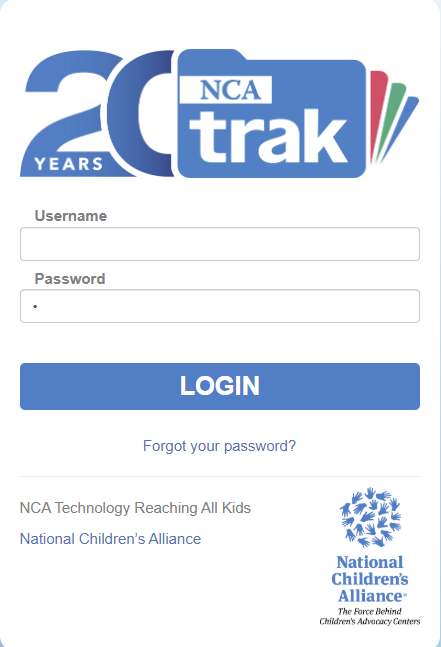
Non-NCAtrak users will be prompted for your center’s log in credentials. The system will be activated for submissions, and you will receive a personal email containing your organization's specific log in information two weeks prior to each deadline. If you have not received this email within the two weeks prior to the submission window, please contact support@ncatrak.org.
NOTE: all your center’s identification information inside the system is connected to this unique Username / Password combination. Make sure the information on your screen is exactly like it is in your email before clicking on ‘Login’. If you experience any problems logging in, please email for assistance to support@ncatrak.org.
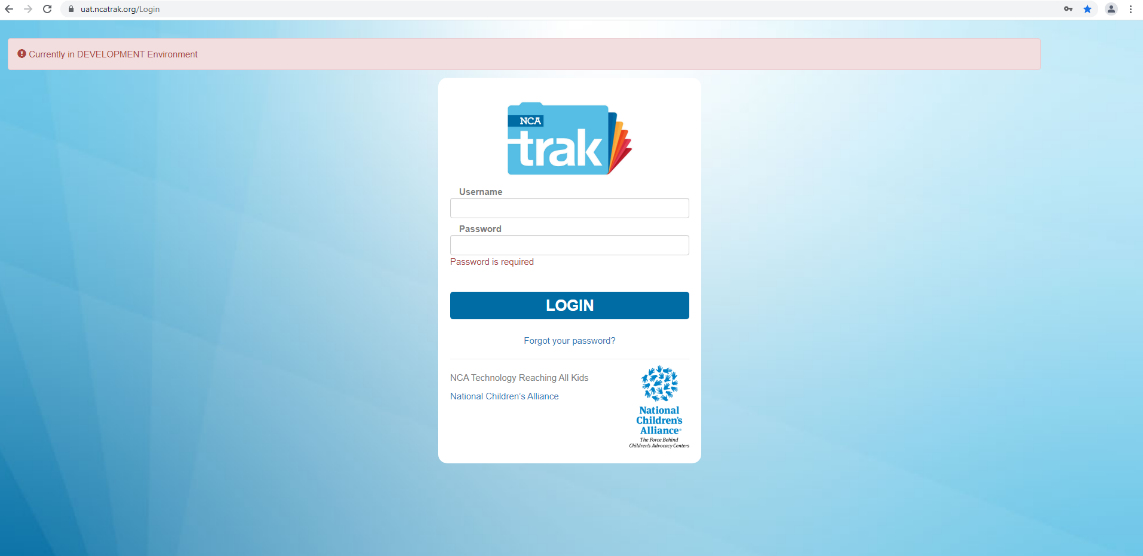
If your login screen has a red bar across the top like in the picture below do not use this this login to enter your statistics. This is our testing environment and the statistics if entered do not go to the proper location and you will be notified that your statistics have not been submitted. Please make sure the website address does not have the letters UAT in the address.
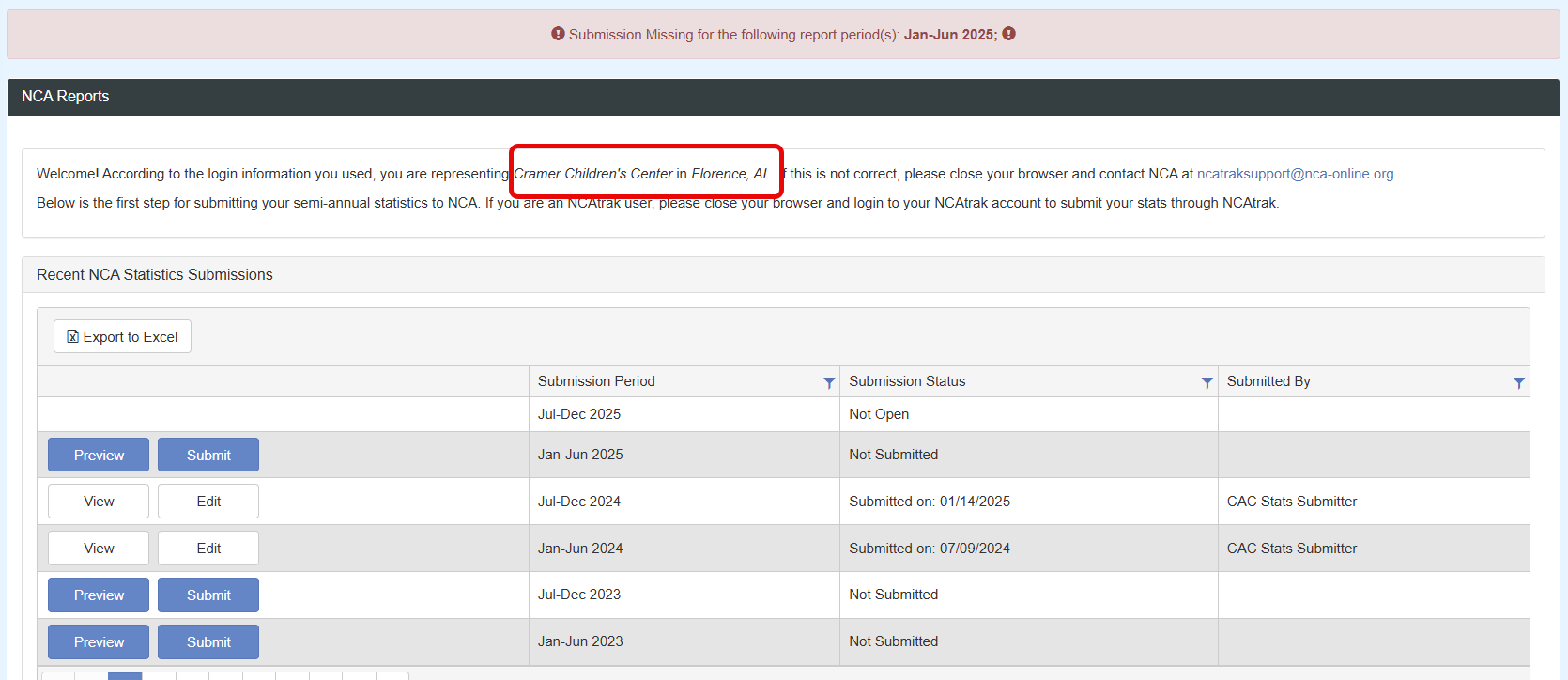
Once logged in this is the screen you will see. Please make sure your CAC name is in the first sentence at the top. Before moving to the next step clear your cache by holding down the Ctrl button on your keyboard and then clicking on the refresh or reload to the right of the URL. The page should refresh.
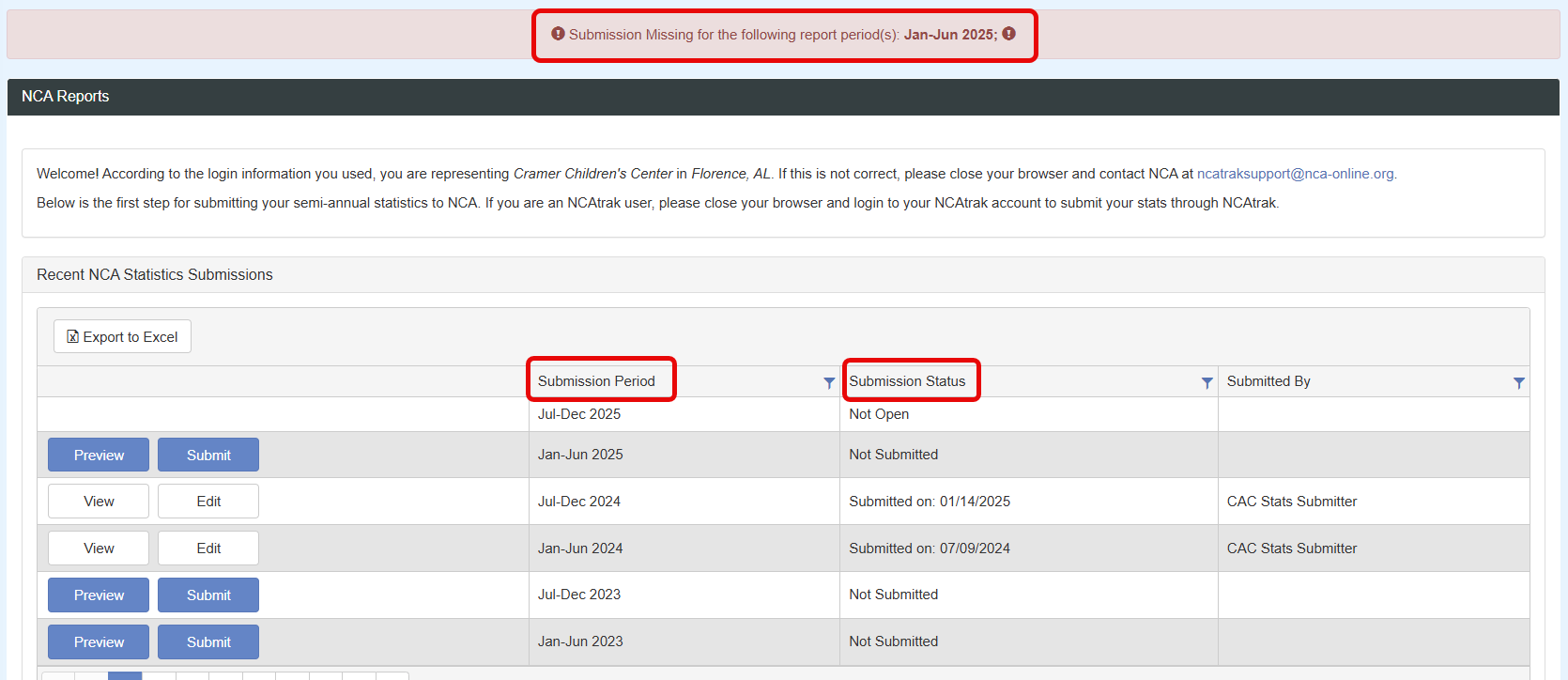
Step 2: Choose the Report that is indicated at the top of the page that has not been submitted:
The submission period should match the period you are submitting statistics and submission status will reflect that the report has not been submitted.
Step 3: Enter your data:
In the first column if the report has not been submitted there will be a preview button and a submit button.
- The preview button downloads a copy of the report in a PDF format.
- The submit button opens the report to allow statistics to be entered.
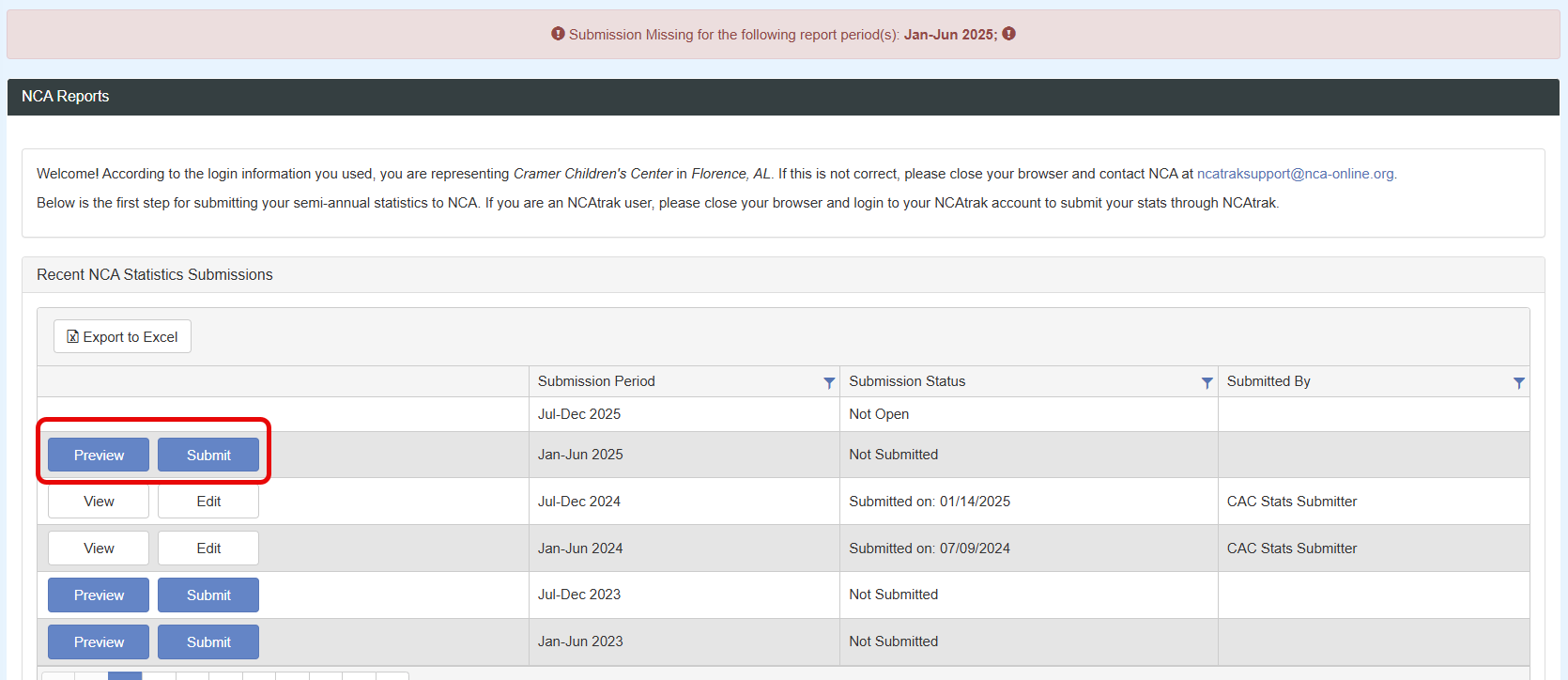
The Statistical Submission Screen
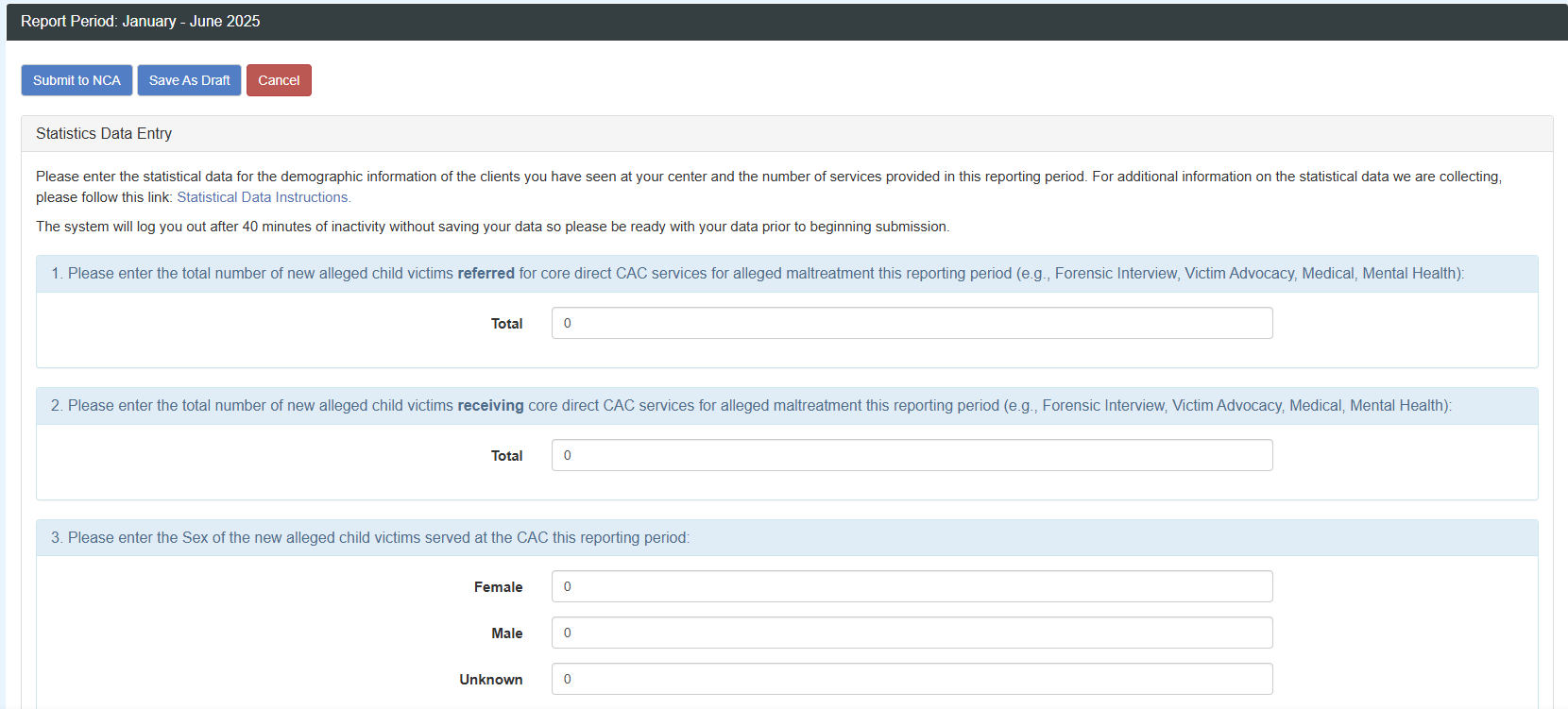
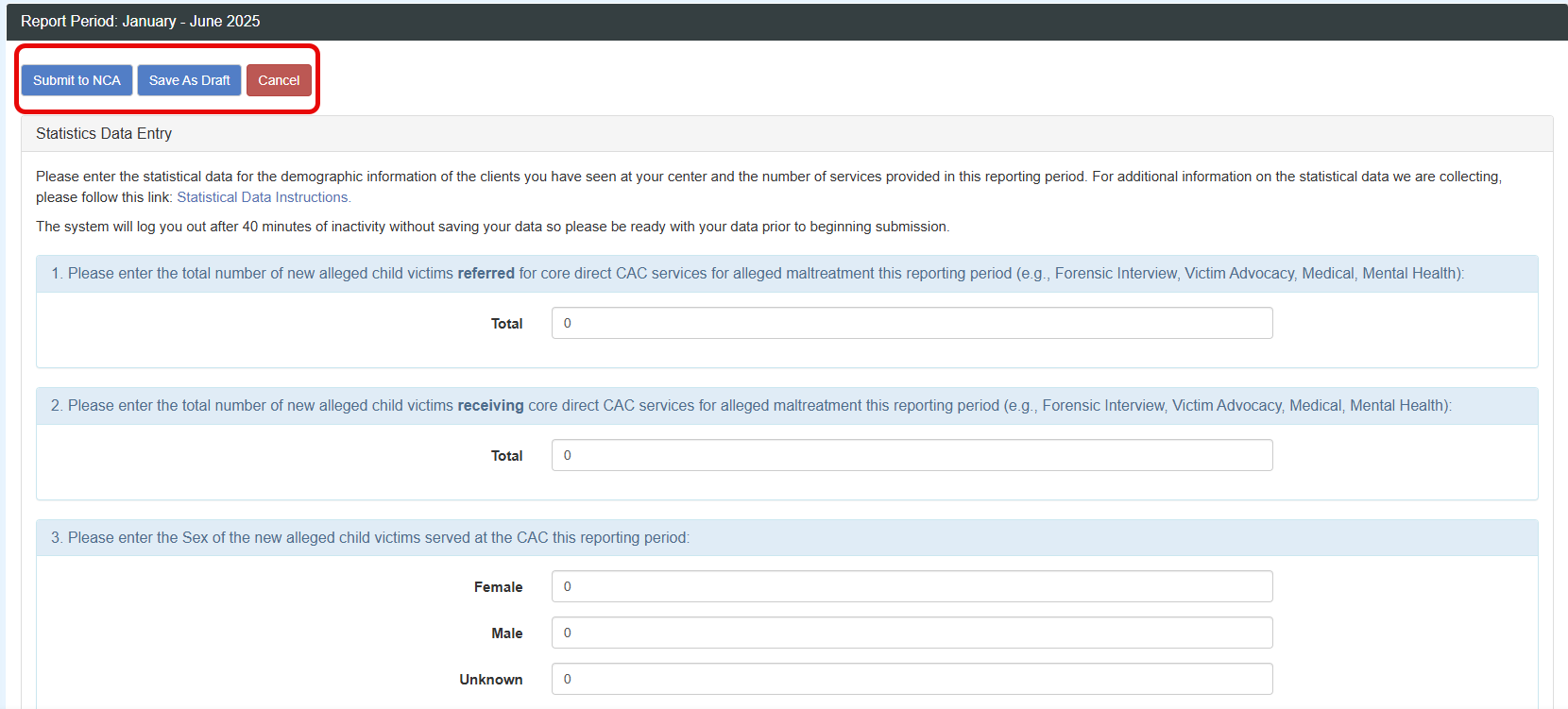
On the Statistical Submission screen you will have the option to submit to NCA once you have entered all your information or Save as Draft to complete at a latter time.
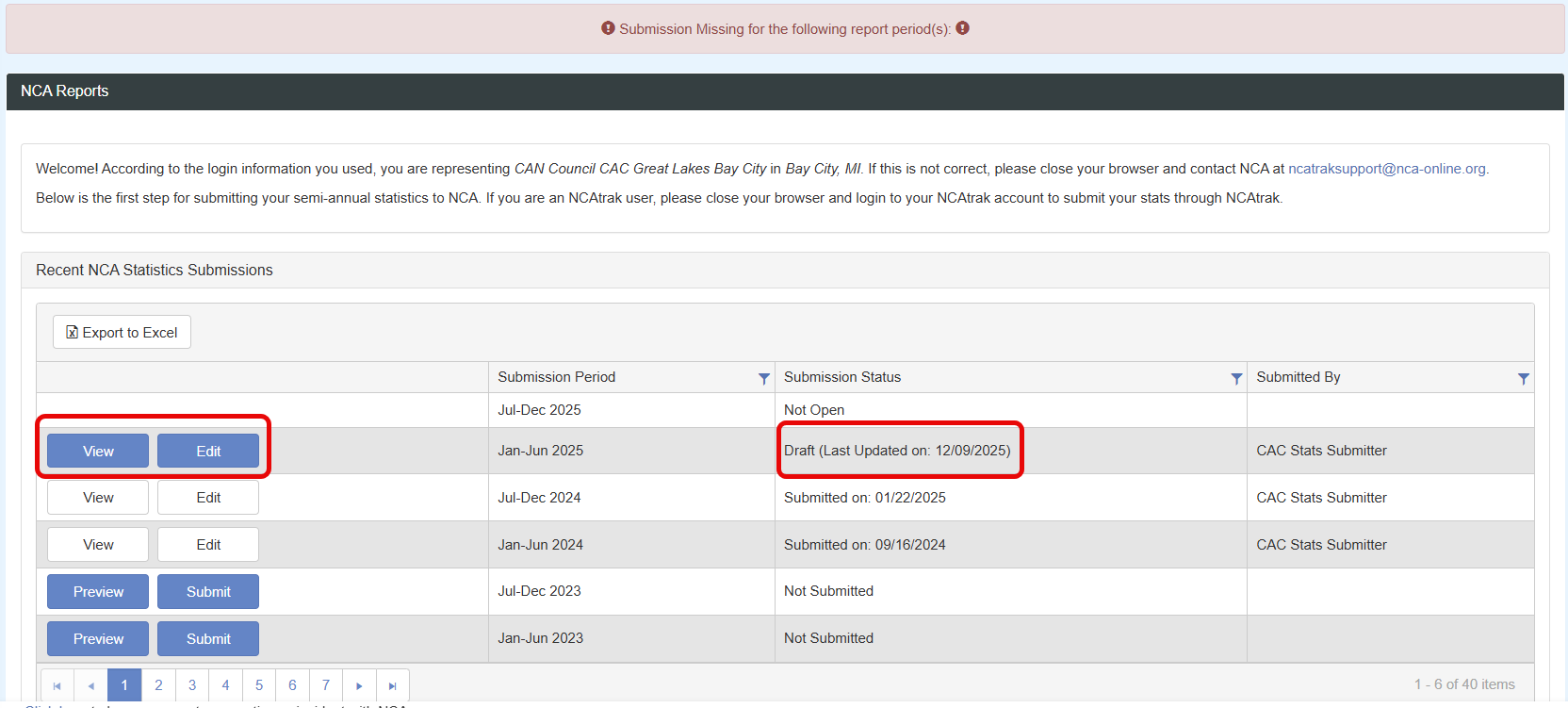
If you save the report as a draft it will change the button from Submit to Edit and will show the submission status as Draft. If you click View it will download a copy of your report in a PDF with the statistics you have entered. If you click Edit you it will load the Statistical Submission screen to edit, save as a draft, or submit to NCA.
Complete the online form, paying special attention to the following sections:
Section 1: Enter number of children and Demographics
Enter the number of Children, demographic information, and services for the children seen by your center.
Question 1, 2 and 3:
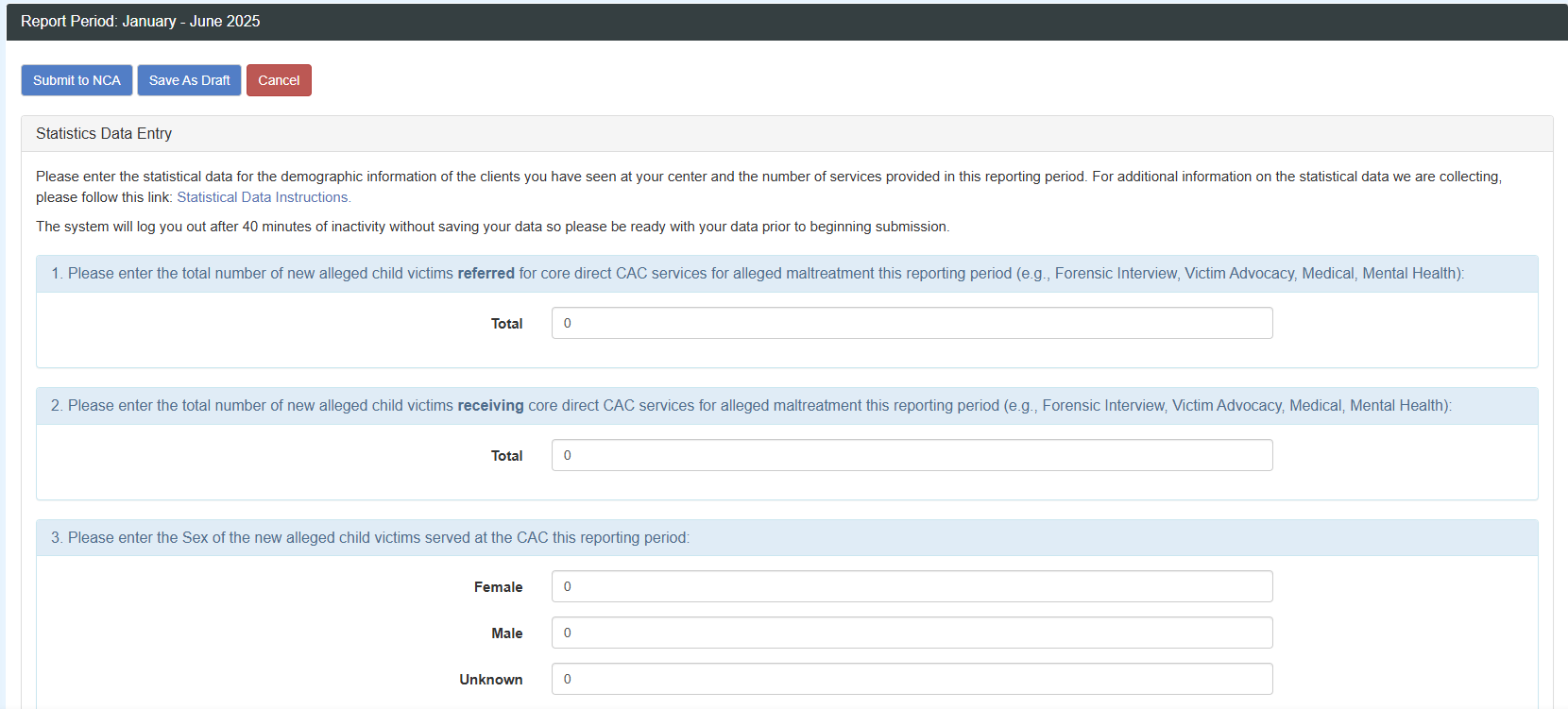
Question 1: Please enter the total number of child victims referred for core direct CAC services for alleged maltreatment for this reporting period (e.g. Forensic Interview, Victim Advocacy, Medical, Mental Health, MDT):
(This includes children who were referred and either have services schedule after the reporting period or there was a referral and no services provided.)
Alleged Child Victim: A person 18 years of age or younger who is referred to the CAC for an allegation of abuse as part of an MDT Investigation.
Note: This is the number of children referred to your center during the reporting period in which your CAC has been involved in the MDT response to an allegation of abuse. DO NOT INCLUDE referrals for services that are outside the core mission of your CAC – include these in ‘Other’ services in the ‘Other Services’ section at the end of this form. ALSO, if a child returns to your center as the subject of a separate allegation of abuse during the reporting period, report the number of allegations (2) as children rather than the number of individuals (1).
Question 2: Please enter the total number of new alleged child victims receiving core direct CAC services for alleged maltreatment this reporting period (e.g., Forensic Interview, Victim Advocacy, Medical, Mental Health, MDT):
(This includes children who were referred and received a service including FI, VA, Medical, Mental Health. This can also include cases assigned who were referred and included in MDT meetings.)
Question 3: Please enter the Sex of the new alleged child victims referred at the CAC this reporting period:
Female
Male
Unknown
Note:
Question 1 and 3 counts new alleged victims 18 or younger who were referred to the CAC for an allegation of abuse and question 3 total should equal question 1 total.
Question 4: Please enter the Race/Ethnicity of the new alleged child victims referred during the reporting period:
Note:
Counts new alleged victims 18 or younger who were referred to the CAC for an allegation of abuse and question 4 total should equal question 1 total.
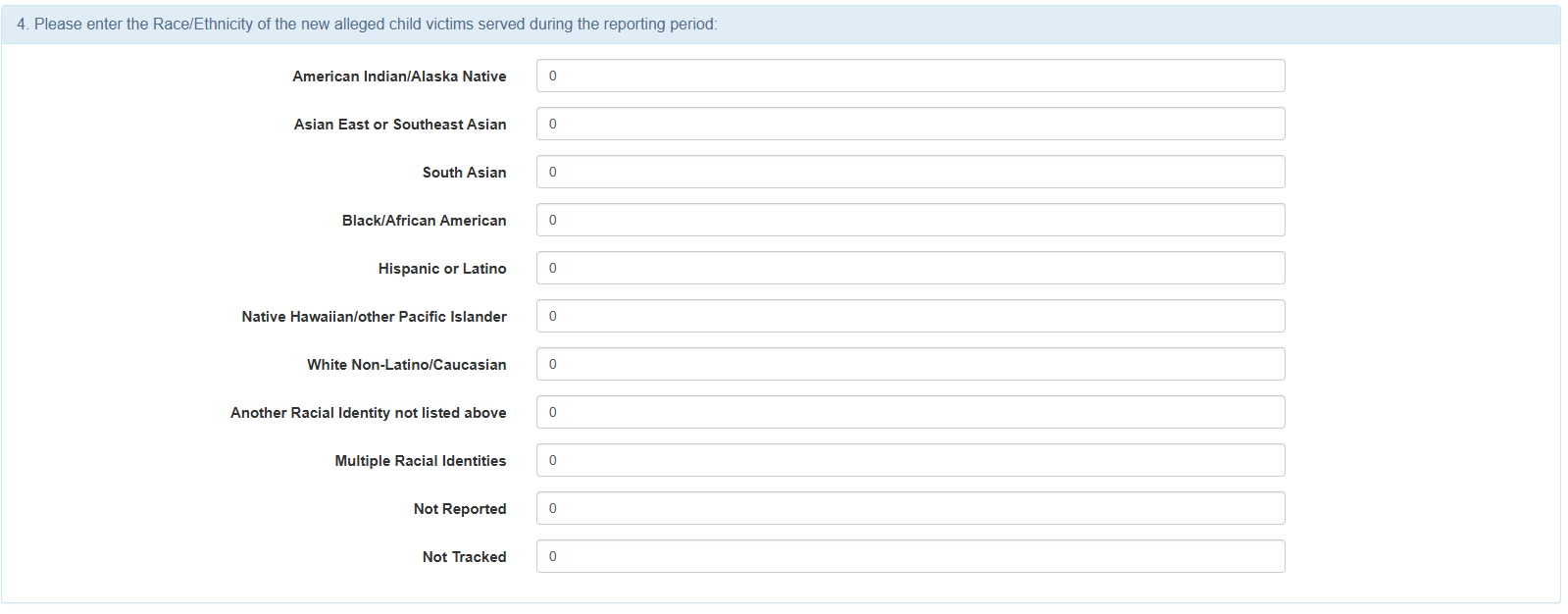
American Indian/Alaska Native
Refers to a person having origins in any of the original peoples of North and South America (including Central America) and who maintains tribal affiliation or community attachment. This category includes people who indicated their race(s) as American Indian or Alaska Native or reported their enrolled or principal tribe, such as Navajo, Blackfeet, Inupiat, Yup’ik, or Central American Indian groups or South American Indian groups.
Asian East or Southeast Asian
Refers to people who are Southeast Asian and come from East Asia: China, Democratic People's Republic of Korea, Mongolia, Republic of Korea. Southeast Asian: Cambodia, Lao People's Democratic Republic, Myanmar, Philippines, Thailand, Viet Nam.
South Asia
Refers to people coming from Afghanistan, Bangladesh, Bhutan, India, Iran, Maldives, Nepal, Pakistan, and Sri Lanka.
Black/African American
Refers to a person having origins in any of the Black racial groups of Africa. It includes people who indicated their race(s) as Black, African American, or Negro or reported entries such as Kenyan, Nigerian, or Haitian.
Hispanic or Latino
Refers to an individual who self-reports in one of the specific Spanish, Hispanic, or Latino categories: Mexican, Puerto Rican, Cuban, or another Hispanic, Latino, or Spanish origin. This also includes people who indicate that they are another Hispanic, Latino, or Spanish origin are those whose origins are from Spain, the Spanish-speaking countries of Central or South America, or the Dominican Republic. The terms Hispanic, Latino, and Spanish are used interchangeably.
Native Hawaiian or Other Pacific Islander
Refers to a person having origins in any of the original peoples of Hawaii, Guam, Samoa, or other Pacific Islands. It includes people who indicated their race(s) as Pacific Islander or reported entries such as Native Hawaiian, Guamanian or Chamorro, Samoan, and Other Pacific Islander or provided other detailed Pacific Islander responses.
White non-Latino Caucasian
Refers to a person having origins in any of the original peoples of Europe, the Middle East, or North Africa. It includes people who indicated their race(s) as White or reported entries such as Irish, German, Italian, Lebanese, Arab, Moroccan, or Caucasian.
Another Racial Identity not listed above
Includes all other responses not included in the race categories described above.
Multiple Races
Refers to a person who may self-identify in more than one race or ethnicity category.
Not Reported
Refers to individuals who do not report.
Not Tracked
Refers to individuals who are anonymous. For example, if a CAC has a client who received services who was anonymous or received referral information over the phone.
Question 5 and 6:
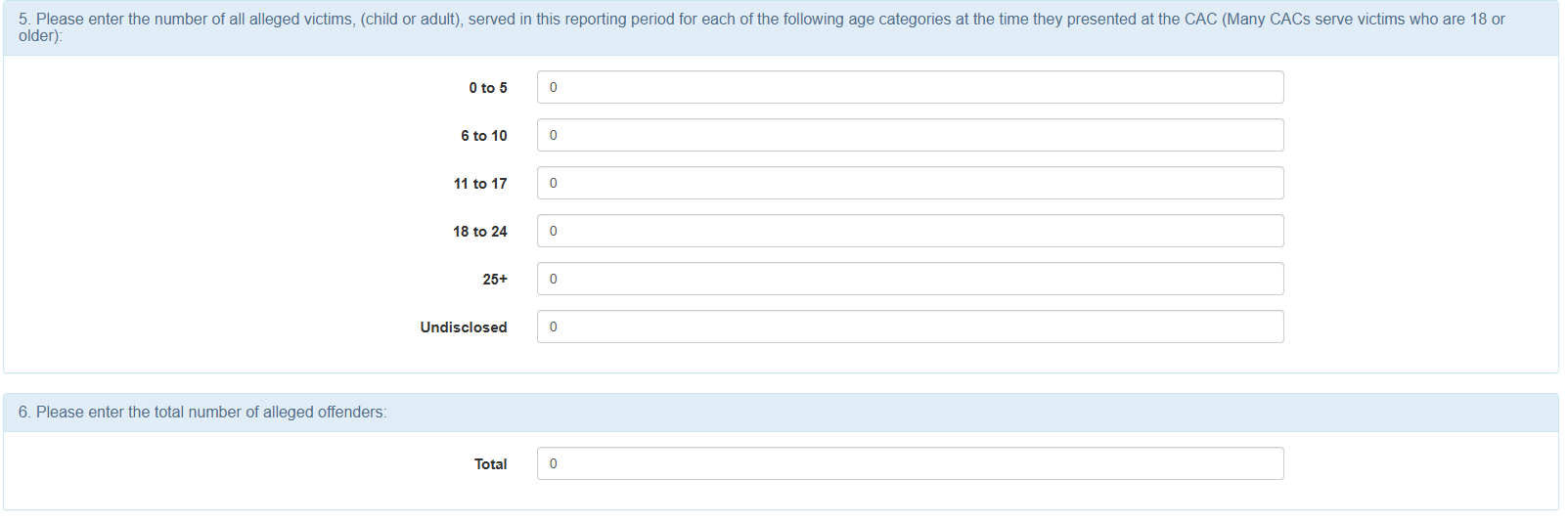
Question 5: Please enter the number of all alleged victims, (child or adult), referred in this reporting period for each of the following age categories at the time they presented at the CAC (Many CACs serve victims who are 18 or older):
0-5
6-10
11 to 17
18 to 24
25+
Undisclosed
Note: The first three categories (0-5, 6-10, and 11-17) total should be equal or less than the total number of children entered in question 1.
Question 6: Please enter the total number of alleged offenders:
Offender, AO, AP
Individuals suspected and investigated in cases of abuse or alleged maltreatment.
Question 7: Please enter the breakdown of the relationship of alleged offenders to the new children served during the reporting period:
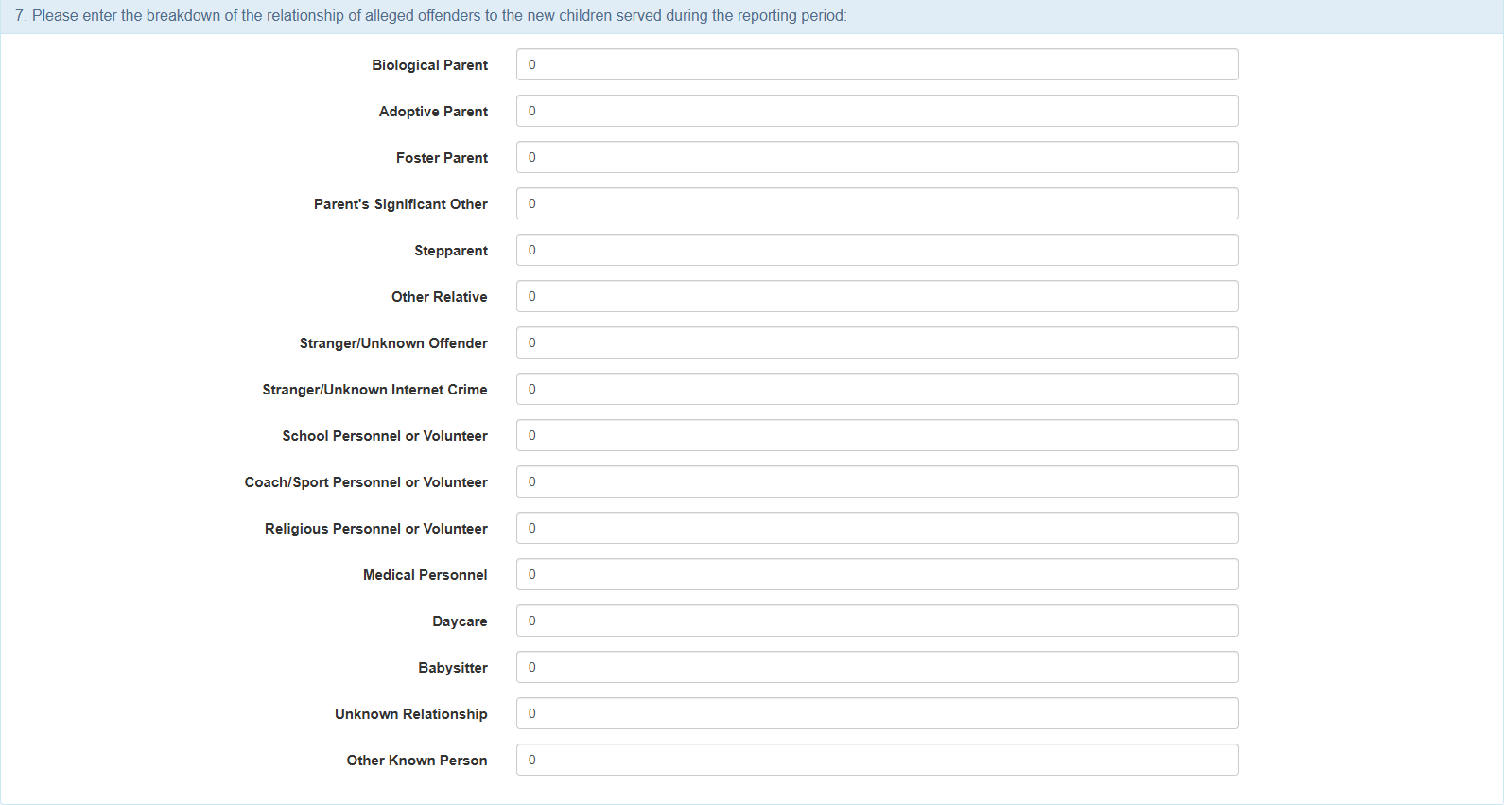
Biological Parent
A person who contributes genetic material to create a child, usually by providing an egg or sperm. Biological parents are genetically linked to their child.
Adoptive Parent
A person who legally becomes a parent to a child who is not biologically related to them.
Foster Parent
An adult who temporarily cares for a child who has been abused, neglected, or whose biological parents are unable to care for them. Foster parents are also known as resource parents.
Parent's significant other
Refers to the romantic partner of a person's parent, essentially meaning their mom or dad's boyfriend or girlfriend; it indicates a person who holds a significant relationship with their parent, even if they are not legally married.
Stepparent
A person who marries one's own parent after the death or divorce of the other parent and therefore has no biological relationship to the child.
Other relative
Refers to family members who are part of your family, such as siblings, aunts, uncles, cousins, and grandparents. It can also include people related by marriage, such as in-laws.
Stranger/Unknown offender
The assailant or offender is completely unknown to the victim or known only by sight.
Stranger/Unknown Internet Crime
The crime occurred by internet or other electronic means and assailant or offenders are completely unknown by the victim or known only by sight.
School Personnel or Volunteer
School personnel are people who work in a school, including teachers, administrators, and support staff. A School Volunteer is a person who helps at a school without receiving payment or other compensation and includes individuals organizing events, mentoring students, and working with students in the classroom.
Coach/Sport Personnel or Volunteer
Is a person who instructs, trains, and directs athletes or sports teams. Personnel would be paid to coach, and a volunteer helps coach without receiving payment.
Religious Personnel or Volunteer
Religious personnel are people who work in a religious vocation or calling, either temporarily or permanently. Religious volunteers are people who contribute their time and talents to a church without receiving payment. They play a vital role in the church by helping to carry out its mission and vision.
Medical Personnel
Medical personnel are people who have received specialized training in a health-related field and work in a medical setting. They may be employed by the military, work in hospitals, or participate in emergency medical teams.
Daycare
Supervision of and care for children or disabled adults that is provided during the day by a person or organization.
Babysitter
A person who goes into the home of a child to give care during the temporary absence of the parent or legal guardian or custodian.
Unknown relationship
A connection between two people where the nature of their bond is unclear, lacking a defined label.
Other known person
A relationship not listed above
Adult Survivor
Someone who has experienced abuse or trauma as a child and is now an adult.
Question 8: Please enter the number of alleged offenders in this reporting period for each of the following age categories at the time they presented at the CAC (each offender should only be counted once and should match the total number of offenders entered):
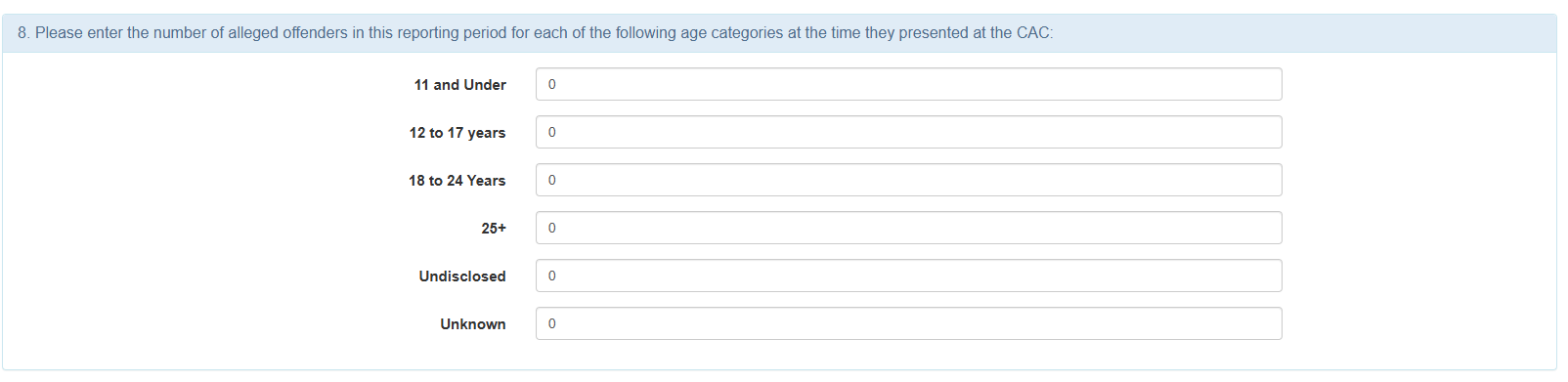
11 and Under
12-17 Years
18-24 Years
25+ Years
Not disclosed
Unknown
Note: Total should equal the total reported in question 7.
Question 9: Please enter the types of abuse reported for the new children served during the reporting period:
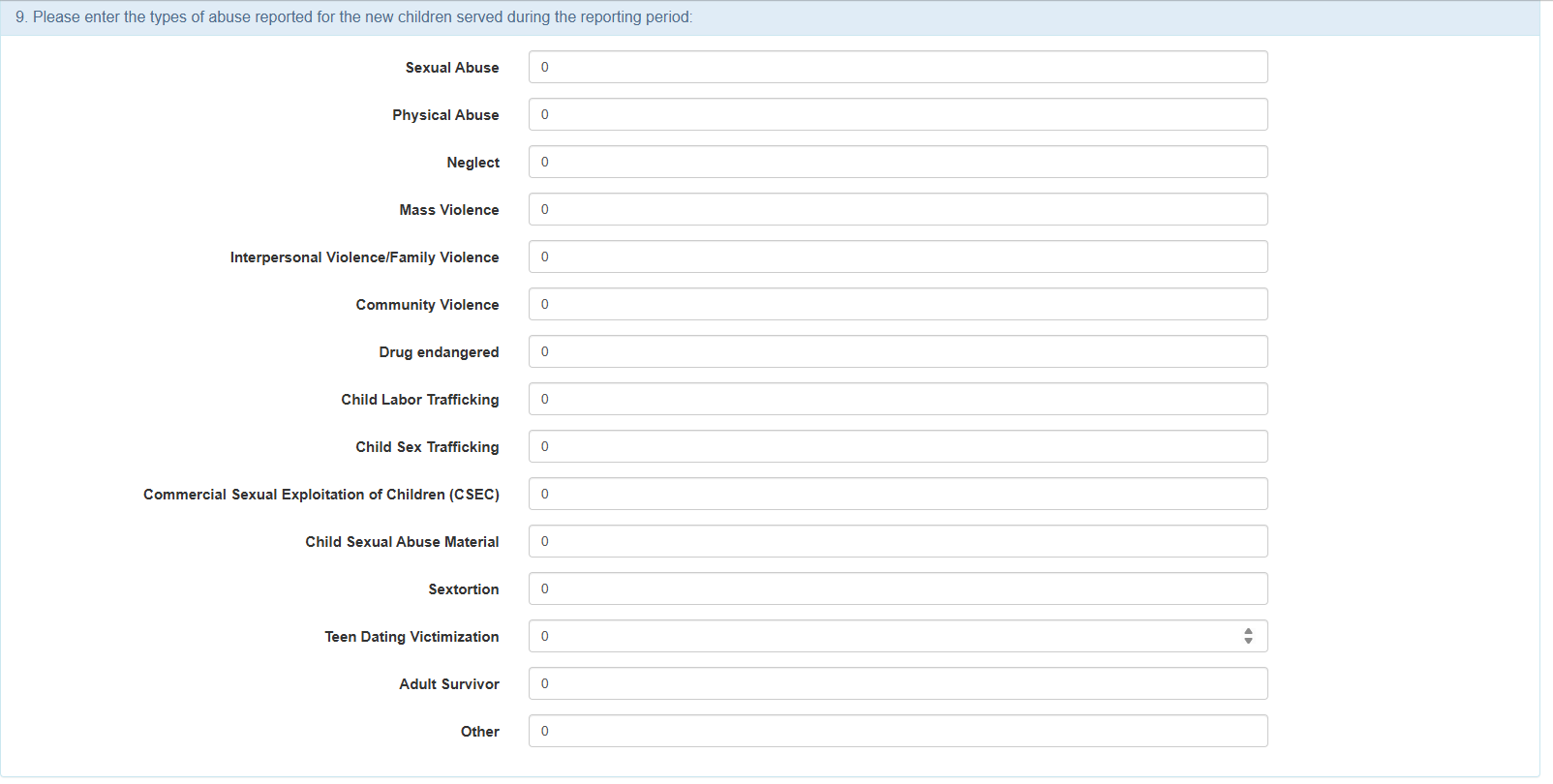
Sexual Abuse
Refers to a specific type of child maltreatment where the abuse is sexual in nature.
Physical abuse
Any intentional act that causes injury or trauma to another person through bodily contact. This can include hitting, kicking, biting, or using weapons. Physical abuse can also include denying a person medical care or forcing them to use drugs or alcohol.
Neglect
Any recent act or failure to act on the part of a parent or caretaker which results in death, serious physical or emotional harm, sexual abuse or exploitation"; or. "An act or failure to act which presents an imminent risk of serious harm."
Mass Violence
Violent, intentional criminal acts that injures or kills many people. Mass violence can include public shootings; Riots; Civil unrest, such as strikes and protests; Terrorism, such as bombings; and public health emergencies, such as disease outbreaks, chemical spills, or radiation events.
Interpersonal Violence/Family Violence
Involves the intentional use of physical force or power against other people by an individual or small group of individuals. Interpersonal violence may be physical, sexual, or psychological (also called emotional violence), and it may involve deprivation and neglect.
Community Violence
Intentional violence that takes place in public spaces between people who are not closely related. It can include bullying, gang fighting, shootings, and attacks.
Drug Endangered
Refers to a child under the age of 18 who lives in or is exposed to an environment where drugs are used or manufactured creating a risk of experiencing abuse.
Child Labor Trafficking
The recruitment, harboring, transportation, provision, or obtaining of a person for labor or services through the use of force or fraud or coercion for the purposes of subjection to involuntary servitude, peonage, debt bondage, or slavery. Child labor trafficking is the trafficking of individuals who are 18 years of age or younger.
Child Sex Trafficking
Refers to the recruitment, harboring, transportation, provision, obtaining, patronizing, or soliciting of a minor for the purpose of a commercial sex act.
Commercial Sexual Exploitation of Children (CSEC)
Refers to a range of crimes and activities involving the sexual abuse or exploitation of a child for the financial benefit of any person or in exchange for anything of value (including monetary and non-monetary benefits) given or received by any person.
Child Sexual Abuse Material
Any visual depiction of sexually explicit conduct involving a person less than 18 years old. Federal law prohibits the production, advertisement, transportation, distribution, receipt, sale, access with intent to view, and possession of child sexual abuse material (CSAM).
Sextortion
The practice of extorting money or sexual favors from someone by threatening to reveal evidence of their sexual activity by sharing with the public nude or sexual images.
Teen Dating Victimization
Teen dating victimization is when a person under the age of 19 experiences abuse, harassment, or stalking by a current or former romantic partner. This abuse can be physical, psychological, or sexual.
Adult Survivor
Someone who has experienced abuse or trauma as a child and is now an adult.
Other
Any Alleged maltreatment not reported above.
Question 10, 11 and 12:
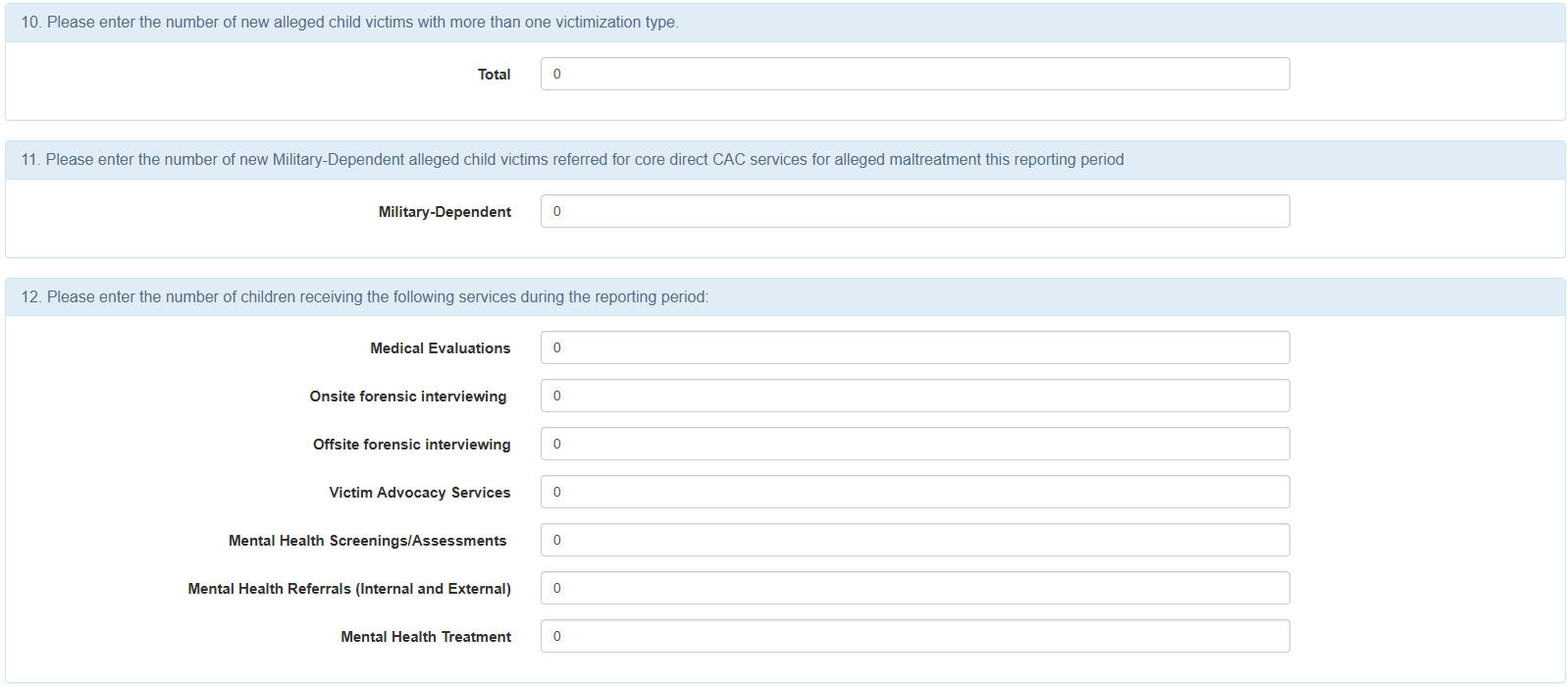
Question 10: Please enter the number of new alleged victims with more than one victimization type:
Question 11: Please enter the number of new Military-Dependent alleged child victims referred for core direct CAC services for alleged maltreatment this reporting period:
Question 12: Please enter the number of children receiving the following services during the reporting period:
Medical Evaluations
Onsite forensic interviewing
Offsite forensic interviewing
Victim Advocacy Services
Mental Health Referrals (Internal and External)
Mental Health Treatment
Special Note:
The sum of the number entered in question 11 may be higher than the total number of new children that you entered in question 1. Question number 11 should reflect the total number of children served during the reporting period and not just the children involved in new cases referred to your center during the reporting period.
Forensic Interview, FI
A structured conversation with a child intended to elicit detailed information about a possible event or events that the child may have experienced or witnessed.
Medical Exam/Treatment/Evaluation
Specialized medical evaluation conducted through a CAC referral to an onsite, linked, or other appropriate medical provider.
Mental Health Counseling/Therapy
Therapy or Counselling either in person or by teletherapy attended by the child.
Mental Health Screenings/Assessments
A mental health screening or assessment is a series of questions and observations that help inform need for treatment, type of treatment needed, and Risk or Crisis Assessment. Screening or Assessments can be conducted by either a Mental Health Professional or a Victim Advocate and typically assess for Trauma, Risk, Crisis, and Safety.
Mental Health Referral to Counseling/Therapy (Internal and External)
Referral for Behavior Health Services or Mental Health Services that are a written, oral, faxed or electronic request by the CAC on behalf of the child.
Victim Advocacy Services
Services that help victims of crime navigate the criminal justice system and recover from their experience.
Section 2: Enter outcome information of cases:
Note:
Accredited programs, as noted in the NCA Standards for Accredited Members, are required to track outcome information. The statistical reporting form should be used and completed in its entirety by those members. While NCA recognizes Associate Member programs may have challenges in tracking outcome information, we ask that you complete the information below to the best of your ability.
Question 13 and 14:
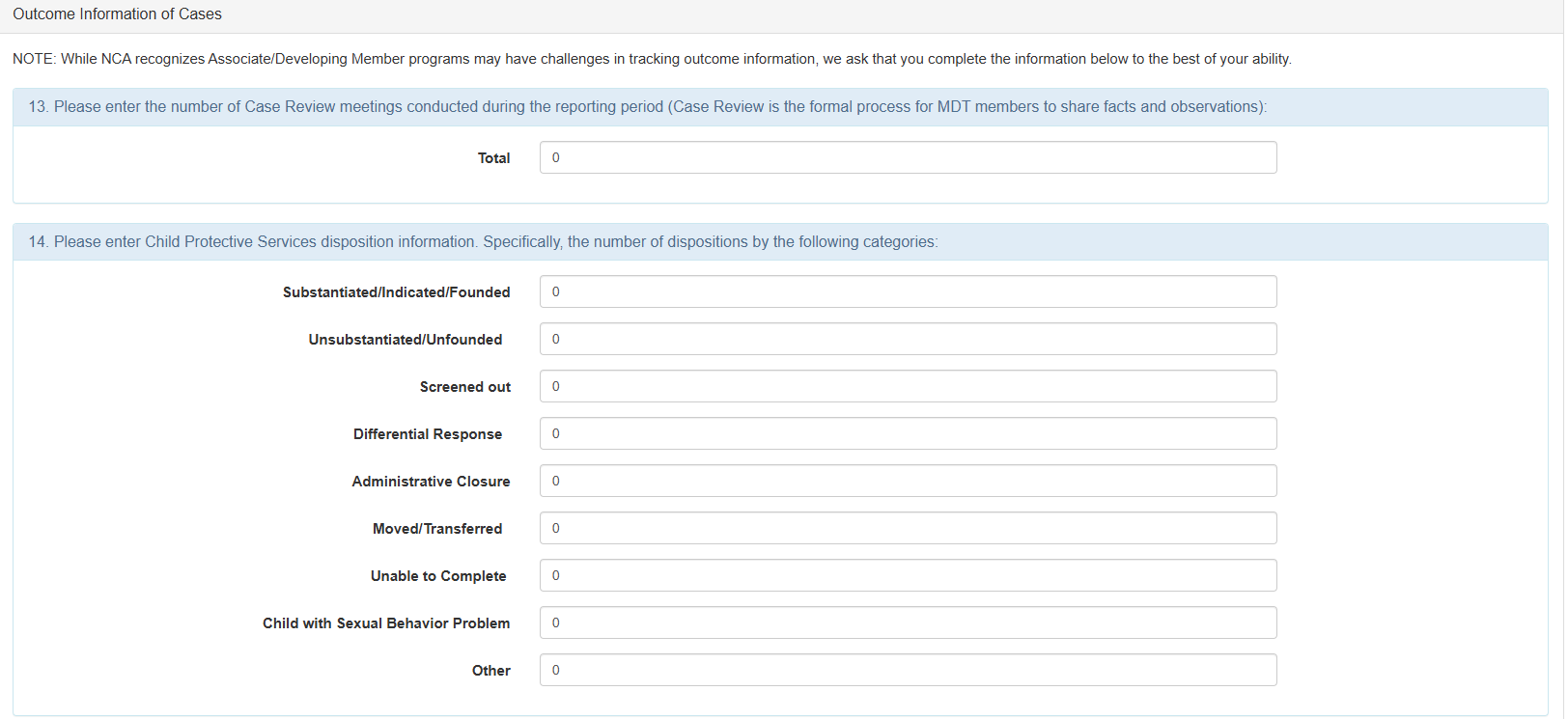
Question 13: Please enter the number of Case Review meetings conducted during the reporting period (Case Review is the formal process for MDT members to share facts and observations):
Case review
The formal process through which professionals share facts and observations that inform team decisions and assist participating professionals to make decisions about cases. Also referred to as MDT Meetings.
Question 14: Please enter Child Protective Services disposition information. Specifically, the number of dispositions by the following categories:
Substantiated/Indicated/Founded
The case was investigated by CPS and the evidence substantiated abuse.
Unsubstantiated/Unfounded
The case was investigated by CPS and no determination of abuse was made.
Screened out
The agency determined that the allegations did not meet the state's definition of child maltreatment.
Differential Response
A child welfare practice that allows multiple ways to respond to reports of child abuse or neglect, is also known as "dual track," "multiple track," or "alternative response".
Administrative Closure
Case that does not meet criteria to be assigned to CPS.
Moved/Transferred
Case where the child/family has moved out of the service area or the case was moved to ongoing services.
Unable to Complete
The case was investigated by CPS and the caseworker was unable to substantiate abuse or complete the investigation for other reasons.
Child with Sexual Behavior Problem
A child who initiates sexualized behaviors that is considered to be developmentally inappropriate for their age and could potentially harm themselves or others.
Other
Cases closed for reasons not provided above.
CPS refers to Child Protective Services
In your state this may be called Department of Children and Families, Department of Human Services, or another name. We recognize CPS as a general term.
Note:
Please only enter the Child Protective Services disposition information for cases (meeting the CAC’s case
acceptance criteria) that CPS closed during the reporting period by the listed categories.
Question 15: Please enter any Prosecution Dispositions/Results that occurred during the reporting period:
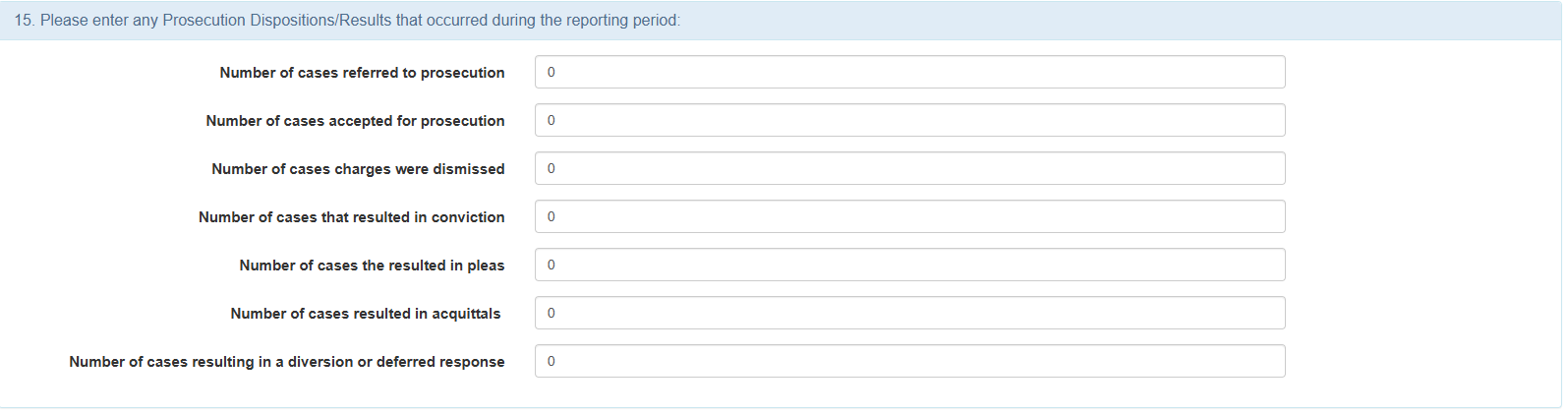
Referred to Prosecution
A request was made to prosecute the case.
Accepted for Prosecution
A Decision to pursue legal action has been made by Prosecution.
Dismissed
The case has been terminated or dismissed because the plaintiff or prosecution did not actively pursue it.
Conviction
For the purposes of this question, please count a case under ‘convictions’ if any of the charges connected to the case resulted in a conviction by jury / judge decision.
Pleas
Count a case under ‘pleas’ if any of the charges connected to a case resulted in a conviction by a plea agreement.
Acquittals
Please count a case under ‘acquittals’ if any of the charges connected to a case did not result in a conviction by jury / judge decision.
Diversion Response
A criminal justice agreement that allows a defendant to avoid arrest, prosecution, or incarceration. In exchange, the defendant agrees to complete certain conditions within a set time frame. If the defendant complies with the conditions, the charges are dismissed.
Note:
For the purposes of this question, please count a case under ‘convictions’ if any of the charges connected to the case resulted in a conviction by jury / judge decision. Please count a case under ‘pleas’ if any of the charges connected to a case resulted in a conviction by a plea agreement. Please count a case under ‘acquittals’ if any of the charges connected to a case did not result in a conviction by jury / judge decision.
For questions 14 and 15 the numbers entered will most likely include cases from previous reporting periods. CPS and Prosecution information is usually information that is not available the following six months after opening the case and therefore the outcomes will most likely be reported during future reporting periods.
Section 3: CAC Information
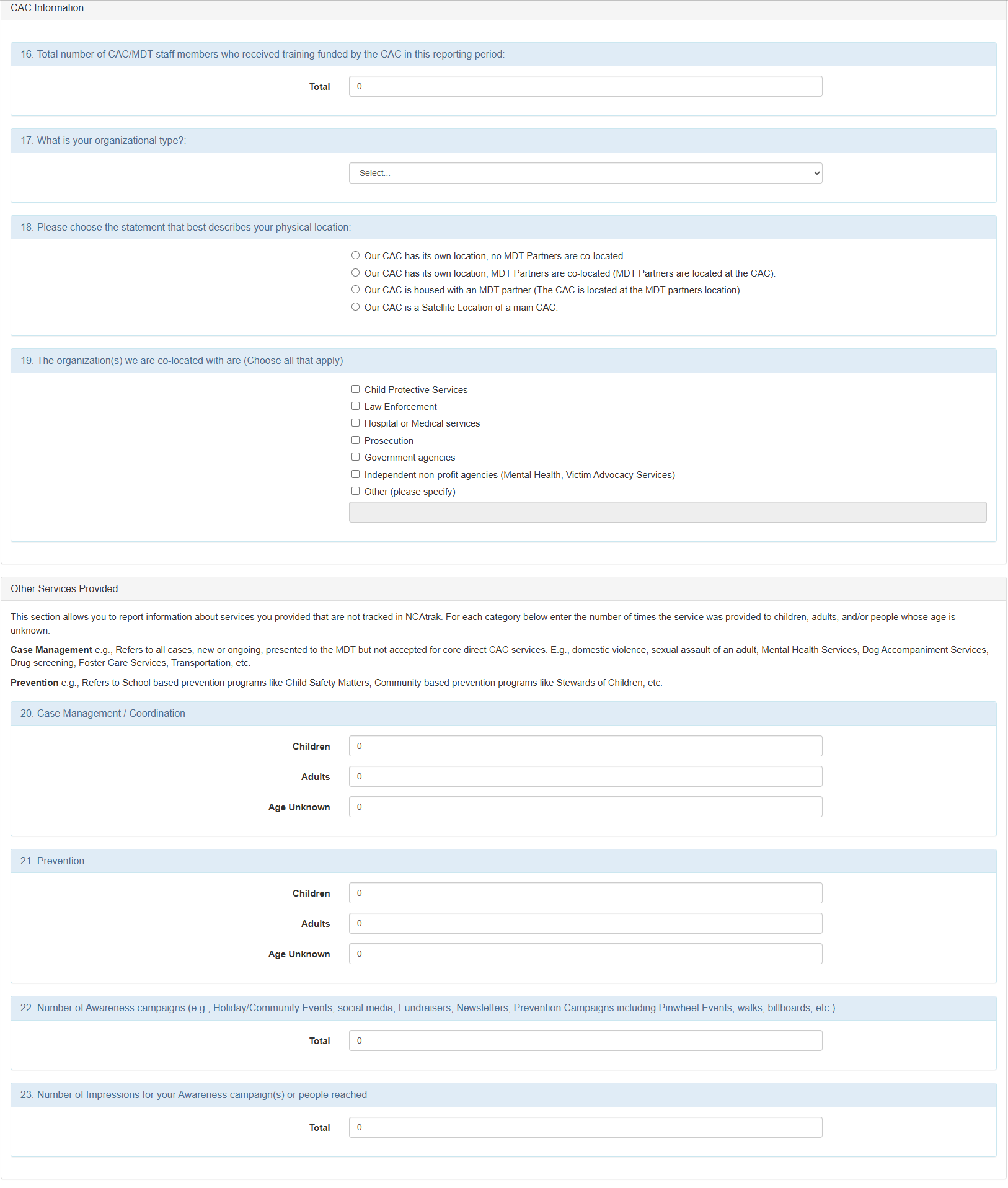
Question 16: Total number of CAC/MDT staff members who received training funded by the CAC in this reporting period:
CAC Funded Training
Includes any MDT member who attended training paid for by the CAC either for the training or for the hours to attend the training.
Question 17: What is your organizational type:
Independent 501c3
Program under an umbrella that is a 501c3
Hospital based CAC
Prosecutor/Government based CA C
Law Enforcement/Government based CAC
Child Protective Service/Government based CAC
Other Government based CAC
Hybrid CAC (e.g., prosecution based with a non-profit arm)
Tribal CAC
Other
Organizational Type
Defines how your CAC operates and is organized for business purposes.
Question 18: Please choose the statement that best describes your physical location:
Our CAC has its own location, no MDT Partners are co-located.
Our CAC has its own location, MDT Partners are co-located. (MDT Partners are located at the CAC).
Our CAC is housed with an MDT partner. (The CAC is located at the MDT partners location).
Our CAC is a Satellite Location of a main CAC.
Physical Location
Describes the physical location of your CAC.
Question 19: The organization(s) we are co-located with are (Choose all that apply)
• Child Protective Services
• Law Enforcement
• Hospital or Medical services
• Prosecution
• Government agencies
• Independent non-profit agencies (Mental Health, Victim Advocacy Services)
• Other (please specify)
Other Services Provided by the CAC during the reporting period:
Question 20: Case Management - e.g., Refers to all cases, new or ongoing, presented to the MDT but not accepted for core direct CAC services. E.g., domestic violence, sexual assault of an adult, Mental Health Services, Dog Accompaniment Services, Drug screening, Foster Care Services, Transportation, etc.
• Children
• Adults
• Age Unknown
Case Management/Coordination (services for children and/or adults)
Referring to cases presented to the MDT but not accepted for core direct CAC services. E.g., domestic violence, sexual assault of an adult, Mental Health Services, Dog Accompaniment Services, Drug screening, Foster Care Services, Transportation, etc. If you enter cases in NCAtrak on the Presenting Tab for Other Direct or Indirect Services statistics will automatically be added to your report if any services like MH, VA, Med, or FI are attended by the client.
Question 21: Prevention - e.g., Refers to School based prevention programs like Child Safety Matters, Community based prevention programs like Stewards of Children, etc.
• Children
• Adults
• Age Unknown
Prevention – Services (for Children and Adults)
Many CACs engage in prevention services. Some have formal programs in the school, others may have groups focused on prevention efforts, and others participate in collaborative community projects. (e.g., School-based prevention programs like Child Safety Matters or community-based prevention programs like Stewards of Children, etc.) If you enter cases in NCAtrak on the Presenting Tab for Other Direct or Indirect Services statistics will automatically be added to your report if any services like MH, VA, Med, or FI are attended by the client.
Question 22: Number of Awareness Campaigns (e.g., Holiday/Community Events, social media, Fundraisers, Newsletters, Prevention Campaigns including Pinwheel Events, walks, billboards, etc.)
Awareness Campaigns
e.g., Holiday/Community Events, social media, Fundraisers, Newsletters, Prevention Campaigns including Pinwheel Events, walks, billboards, etc.
Question 23: Number of Impressions for your Awareness campaign(s) or people reached
Awareness Campaign Impressions
The number of projected or determined people reached through awareness campaigns.
Step 4: Submit your Statistics
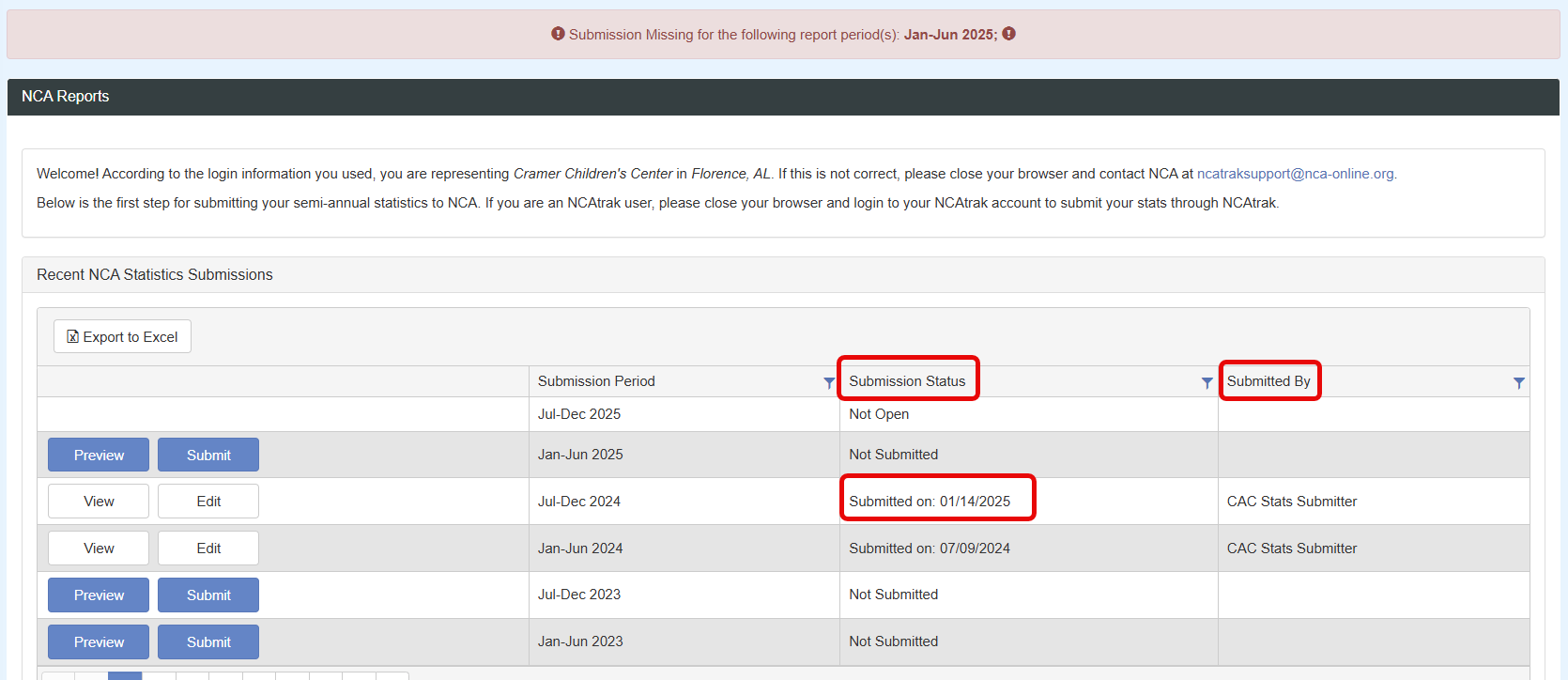
If your submission is successful, the screen will look like the picture above and include a submitted on with a date in the submission status column.
Note: If the Statistical Submission Form appears after you have clicked on the Submit button, scroll up and review the screen again – NCAtrak has uncovered an error.
You can print a copy of your submission for your files after submitting. On the initial landing page, use the blue ‘View’ button. All your NCA report submissions will list including the report just submitted. After clicking view a PDF of your report will be downloaded.
NOTE: You may not have access to this page shortly after the submission deadline. It is strongly encouraged that you do keep a copy of this information for your records.
Finally, after your statistics are submitted if information changes or if new information is received you can press the ‘Edit’ button for the report period you wish to enter the new information.
Step 5: SUBMISSION DEADLINE
- Jan 15th of each calendar year- submission of January-June and July-December data.
- Regardless of which day of the week the submission date falls on each year, the submission system is closing at 11:59 EST on the deadline.
Reports cannot be emailed, faxed, or mailed.
Your account will be activated for submissions, and you will receive your log in information two weeks prior to each submission deadline.
Thank you for all you do for the children. National Children’s Alliance
Please feel free to call (202) 548-0090 ext.125 or email support@ncatrak.org for any questions
Was this article helpful?
That’s Great!
Thank you for your feedback
Sorry! We couldn't be helpful
Thank you for your feedback
Feedback sent
We appreciate your effort and will try to fix the article